.png)
As additive manufacturing (AM) continues its drive from R&D playground to production reality, the software conversation is getting noisier. Vendors talk about MES, QMS, PLM, “platforms”, AI layers, digital twins, and data lakes, and more than a few claim to be the one system that can “do it all”.
Buyers, understandably, are left with two simple questions: “Where does this actually fit in my stack? ”, and “Can’t I just implement one piece of software and be done?”
It’s a tempting idea, one jack-of-all-trades system that covers every need. But that’s increasingly at odds with how robust industrial IT landscapes are really evolving. The future lies in specialised services implemented in the right place, not a single monolithic application that tries to be ERP, MES, QMS, monitoring and analytics all at once.
In practice, that means focused tools (each excellent at its job) connected through clean APIs. Quality, production, engineering, and IT each get an environment that fits their work, while data flows reliably between systems in the background. The alternative is either an all-encompassing “SAP-for-everything” that pleases no-one, or a patchwork of in-house developments that quickly become expensive to maintain. Writing software once is easy; maintaining and evolving it over years is the real cost many engineering teams underestimate.
In that context, defining amsight as production-level QM software for AM, a digital quality backbone alongside MES in the production layer, connecting machines and inspection with the rest of the stack – is not about adding “just another tool”, but about putting a specialised service in exactly the right place so everything else can stay simpler.
For CTOs, IT leaders, and integration partners, that question matters more than any individual feature. If you can’t place a tool in your architecture, you can’t scale it.
This blog lays out a clear view of where amsight fits, as a production-level QM software for AM, connected to MES, ERP as well as machines/sensors (IPMS) - adding essential quality management functionalities your MES, ERP and in-situ monitoring solutions (IPMS) don’t have.
ERP, MES, QMS & IPMS
Most industrial AM environments already run some combination of:
- ERP (to manage orders, customers, finance and inventory)
- MES (to schedule work, dispatch jobs and track progress on the shop floor), and
- QMS (to define procedures, documents, approvals and audits [e.g. ISO 9001])
- IPMS – In-Process Monitoring System (to evaluate build quality in high detail)
These systems are essential, but they were not designed around end-to-end powder-bed AM quality data. They don’t intuitively understand a build job, a parameter set, a powder refresh strategy, or the relationship between a CT scan and powder properties.
The result? AM teams quietly fall back to Excel, PDFs, and shared folders to manage production-level quality data, even in highly digital organisations.
The missing piece: production-level QM software for AM
Next to MES workflows and high-level QMS policies there is a gap: a place where actual, granular quality data should live.
That ‘missing piece’ needs to:
- Collect data from printers, post-processing and inspection systems
- Link it to powder, builds and parts in a consistent data model
- Provide tools for traceability, SPC, root-cause analysis, and reporting
- Expose all of this back to MES/ERP/QMS through Application Programming Interfaces (APIs)
This is what amsight is made for.
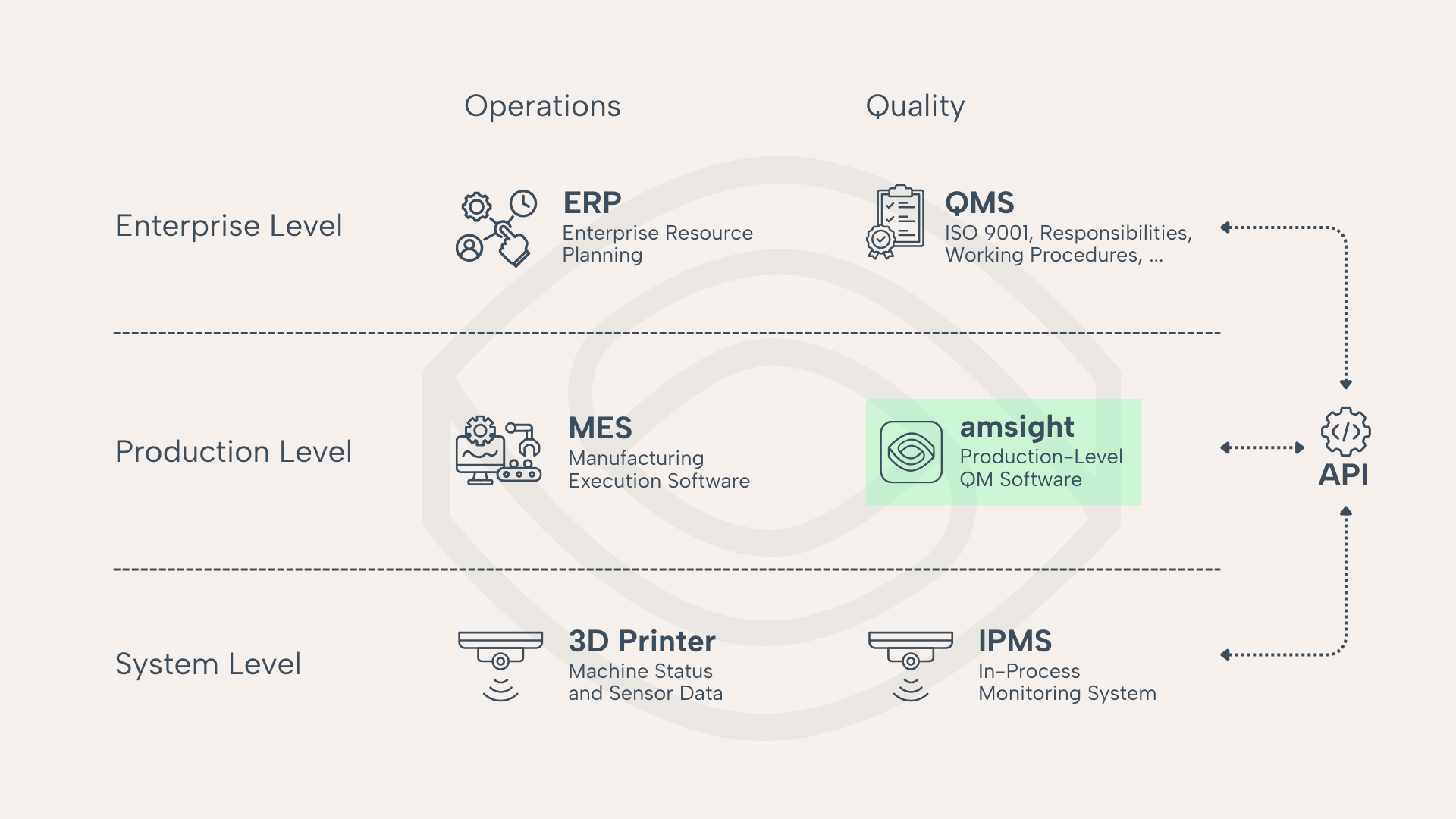
It is not trying to be your MES. It doesn’t schedule jobs, manage quotes, or orchestrate logistics. Instead, it acts as a digital quality backbone for AM, purpose-built around powder-to-part data, end to end.
Think of it as: ERP (business) → QMS (define standards & procedures) → MES (workflow) → amsight (end-to-end AM quality data) → IPMS (machines & sensors data).
.png)
Why a dedicated AM quality management software is needed
From an IT perspective, it’s fair to ask: “Why can’t MES or generic QMS just do this?”
Main reasons:
- Data model: MES usually thinks in terms of orders and operations. QMS thinks in terms of documents and procedures. Neither is optimised for dense, multivariate AM process data across powder, process and inspection. amsight’s data model is built precisely around those entities.
- Depth of integration: AM fleets are heterogeneous. Different OEMs, generations, log formats and inspection systems all need to be normalised. amsight focuses narrowly on ingesting, harmonising and enriching AM-specific quality data so other systems don’t have to.
- Regulated-industry expectations: In sectors like aerospace, medical and semiconductor, auditors increasingly expect process-level evidence, not just final reports. The amsight software is where that evidence lives: complete, query-able and tied to recognised standards frameworks.
- Statistical Process Control and data-driven process optimization is not effective, with scattered data. However, it is essential for operating an AM production in regulated industries and is a real competitive edge, once implemented.
What this means for CTOs and IT
For technology leaders, a production-level QM software solution for AM changes the conversation in three ways:
1. Clear boundaries and responsibilities
- ERP remains the system of record for customers, orders and finance
- MES continues to orchestrate operations
- QMS governs procedures and compliance frameworks
- IPMS evaluates build quality and anomalies
- amsight owns production-level quality data for AM (powder, process, post-processing, inspection, SPC and reports)
That clarity makes architecture diagrams (and security reviews) far simpler.
2. Integration once, reuse everywhere
By integrating printers, post-processing, and inspection systems into amsight, you create a reusable quality data service. Instead of ad-hoc point integrations from each machine to each system, amsight becomes a single, well-defined interface for AM quality data.
3. Industrialisation without an ERP-scale project
Because amsight focuses on a narrow but deep problem (AM quality data), implementations can start small:
- One site or product line
- A defined set of machines and inspection flows
- A clear path to expand once value is proven
That’s very different from a multi-year MES or ERP replacement. For IT, it means controlled scope, manageable risk, and architecture that respects what’s already in place.
What this means for partners
For machine OEMs, integrators and qualification specialists, a production-level quality software solution is a way to future-proof projects:
- OEMs can deliver machines that “speak” into a digital quality backbone rather than one-off spreadsheets
- Integrators can offer cleaner architectures where amsight is the designated quality layer
- Partners working on standards and certification can tie their frameworks to a concrete data implementation, not theory alone
Putting it all together
Production-grade AM doesn’t need a single system to do everything. It needs a stack in which each piece is excellent at its job, and plays well with the others.
Defining amsight as the production-level QM software for AM brings that stack into focus. It clarifies where quality data lives, how it flows, and how ERP, MES, QMS and IPMS can finally rely on a single, trusted view of powder-to-part reality.
For CTOs and IT teams, that’s the difference between “yet another AM tool” and a piece of architecture that genuinely moves AM toward scalable, certifiable, industrial production.
Related articles
.png)
Blog Post
Architecting an Additive Manufacturing Software Stack
amsight doesn’t replace your MES or ERP - it fills the critical gap between them by owning the AM-specific quality evidence chain, so you stop assembling audit packs from spreadsheets and start proving part-level traceability, SPC, and process stability from powder to final inspection.
Aug 31, 2026
.png)
Blog Post
Process-Centred vs Part-Centred Thinking in Regulated Additive Manufacturing
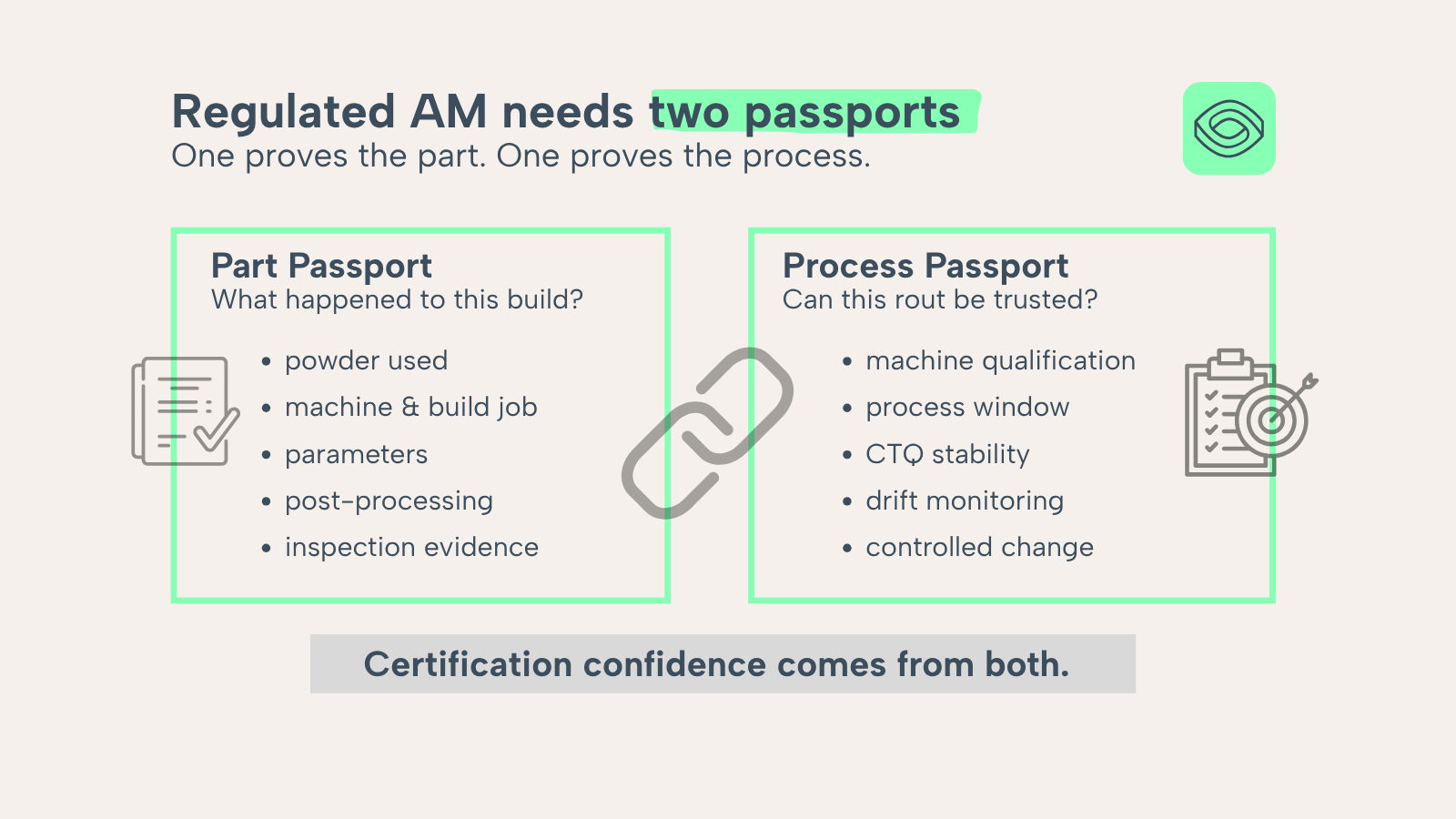
Regulated AM customers are not only asking whether a part conforms. They want to know whether the process behind it is stable, repeatable and controlled. This article explains why mature AM suppliers need both a part passport and a process passport.
Jul 28, 2026
Let's Talk About Your AM Production
Book a call and we'll discuss your process, requirements as we share our findings and walk through why we built amsight.