.png)
A lot of AM “quality management” is still along the lines of, you produce the part, then you gather evidence to prove it passed, and when something fails, you run an investigation, write a report, and hope the next build behaves. That’s compliance. It’s not continuous improvement.
Operations leaders care about something different, essentially does the process get more stable over time? Does scrap fall? Do rework cycles shrink? Does inspection burden reduce because the process is under control, not because you got lucky?
To get there, you need a feedback loop. Not a vague “we’ll look at the data later” loop, a practical, shop-floor loop where inspection outcomes drive process decisions quickly and consistently.
Why the loop breaks in most AM production
In powder-bed AM, the data that matters lives in three different worlds:
- Inspection outcomes: CT results, CMM, tensile bars, surface roughness, defect classifications
- Process parameters and machine context: parameter sets, machine events, maintenance, build layout, environmental conditions
- Powder management: batch IDs, reuse cycles, blends, sieving state, measured powder properties
Most plants record all three. The problem is they record them separately. When a non-conformity appears, the first stage of root cause isn’t analysis, it’s reconstruction — “Which powder was this?” “Which parameter set was active?” “Did anything change after maintenance?” That’s why investigations are slow, and why corrective actions often become conservative rather than precise.
A real feedback loop begins when those three worlds are connected at part level and trended over time.
Shift from “prove” to “predict”
Continuous improvement in AM isn’t about collecting more data. It’s about turning existing data into early-warning indicators.
That’s what SPC is for. It helps you distinguish normal variation from drift, and it gives you a disciplined trigger for intervention before parts go out of spec. The key is to choose CTQs that genuinely predict scrap and rework, then trend them across builds, machines, and powder states.
When SPC is done properly, inspection stops being a post-mortem and becomes a sensor for process stability.
What the feedback loop lookslike in practice
The loop has a simple shape:
- Inspection signals an issue early: Not “this part failed”, but “variance is widening” or “drift is starting.”
- You correlate that signal to process context: Which machine, which parameter set revision, which build layout, what changed recently?
- You overlay powder history: Was this powder at a different reuse count? A different blend ratio? A different sieving state? Did powder properties drift?
- You act through defined quality gates: You don’t improvise. You have pre-agreed responses, refresh powder, tighten a parameter window, trigger targeted extra inspection, check a machine subsystem, or hold a batch for review.
- You verify effectiveness with SPC: The process must trend back into control, otherwise you didn’t fix the root cause, you just paused it.
The important point is that the loop is repeatable. It doesn’t depend on one person’s memory.
Where amsight fits
A feedback loop collapses if every step requires manual data wrangling. That’s why a production-quality data backbone matters. amsight’s Custom Reports & Analytics is the “repeatability engine” in the loop with standardised reporting, trend views, and analysis that doesn’t require rebuilding spreadsheets every time.
And Process & Machine Qualification provides the discipline layer, it’s where CTQs, process windows and stability evidence become part of the operating model rather than a one-off qualification dossier.
Here’s the novel way to think about those two pages together:
- Custom Reports & Analytics turns your data into signals you can act on.
- Process & Machine Qualification turns those actions into repeatable control.
What Ops actually cares about
When this loop is running, three things happen that every production leader recognises immediately:
- Scrap becomes less “mysterious” because drift is detected earlier
- Rework shrinks because corrective action is more precise
- Inspection load reduces over time because stability improves (you stop paying for uncertainty)
This is how AM starts behaving like mature manufacturing with fewer hero investigations, fewer surprises, more predictable output. Quality data isn’t the end of the process. It’s the beginning of improvement, if you close the loop.
Related articles
.png)
Blog Post
Architecting an Additive Manufacturing Software Stack
amsight doesn’t replace your MES or ERP - it fills the critical gap between them by owning the AM-specific quality evidence chain, so you stop assembling audit packs from spreadsheets and start proving part-level traceability, SPC, and process stability from powder to final inspection.
Aug 31, 2026
.png)
Blog Post
Process-Centred vs Part-Centred Thinking in Regulated Additive Manufacturing
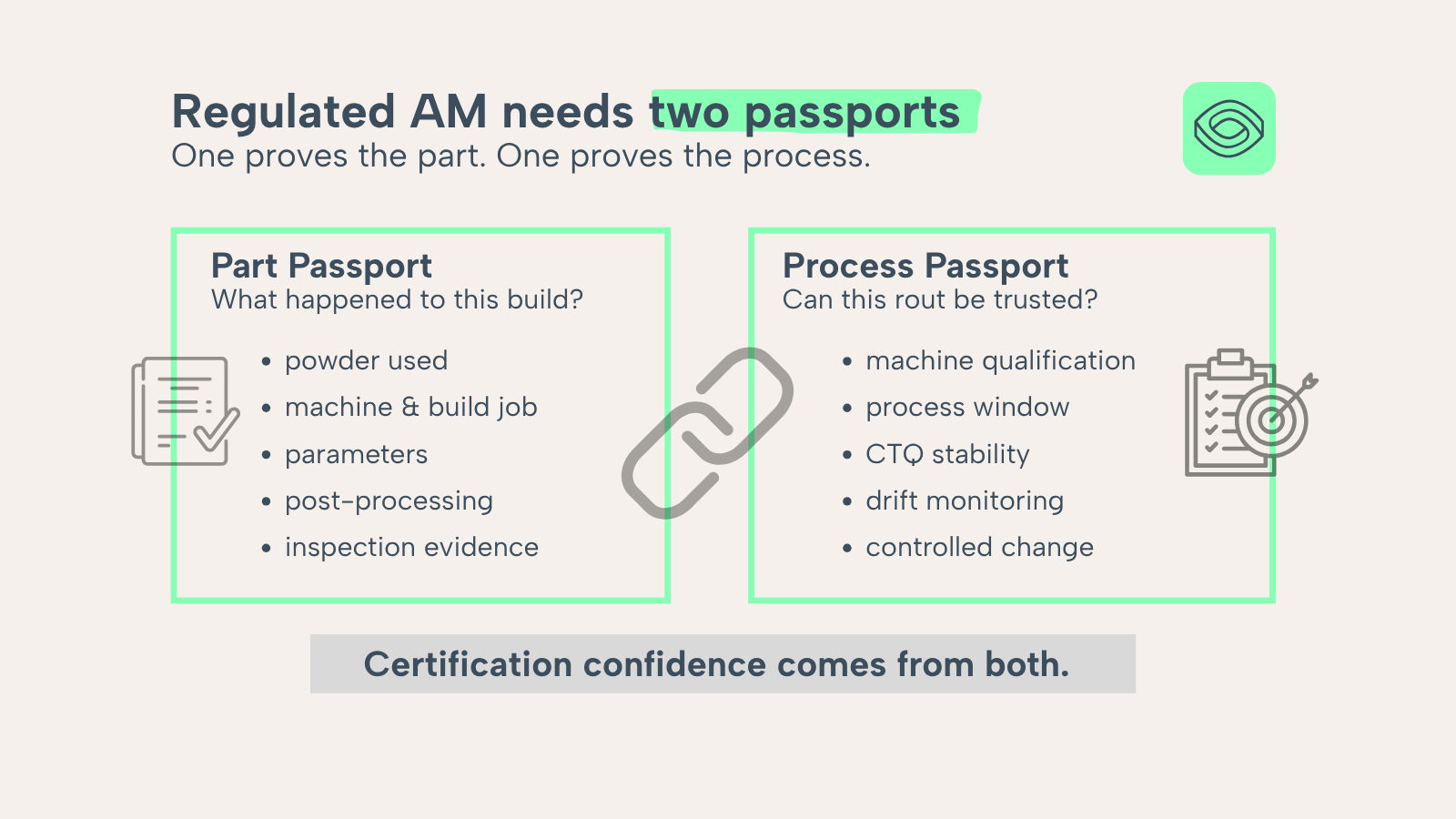
Regulated AM customers are not only asking whether a part conforms. They want to know whether the process behind it is stable, repeatable and controlled. This article explains why mature AM suppliers need both a part passport and a process passport.
Jul 28, 2026
Let's Talk About Your AM Production
Book a call and we'll discuss your process, requirements as we share our findings and walk through why we built amsight.