In regulated additive manufacturing, it is tempting to treat quality as a question answered at the end of production. Did the part pass inspection? Is the CT result acceptable? Do the mechanical test results meet specification? Is the certificate complete?
These questions matter. But they are not enough. For space, aerospace, defence, and medtech applications, certification readiness is not only about proving that an individual part conforms. It is about proving that the process behind that part is stable, repeatable, and controlled. That is a very different mindset.
Part-centred thinking asks “can we prove this item is acceptable?” Process-centred thinking asks “can we prove the system that produced it is dependable?” The second question is where many AM organisations still struggle.
The danger of a “good part” mindset
AM has grown up around impressive parts. The industry is very good at showing what can be made such as lightweight brackets, complex thermal structures, customised implants, RF components, propulsion hardware, topology-optimised designs. But certification bodies and regulated customers do not become confident because one build succeeds. They become confident when the evidence shows repeatability over time.
A good part may show capability. A controlled process shows maturity. That distinction becomes critical when production moves beyond first articles. If every delivery requires a fresh act of documentation reconstruction, or if quality evidence depends on spreadsheets, shared folders, and individual memory, then the process is not really certification-ready. It may be inspection-ready. It may even be audit-survivable. But that is not the same thing.
ISO/ASTM thinking is process thinking
ISO/ASTM standards help the AM industry move beyond “trust us, we printed it” toward controlled, documented, reproducible manufacturing. They create a common vocabulary around qualification, traceability, machine capability, material control, process validation, and inspection.
The opportunity is to treat that vocabulary commercially, not just administratively.
When a supplier can show a customer that powder state, machine data, build information, post-processing, and inspection results are connected in one evidence chain, the conversation changes. Instead of waiting for an audit to expose gaps, the supplier can demonstrate maturity upfront.
This matters because regulated customers are not only assessing parts. They are assessing supplier risk.
Two passports - the part and the process
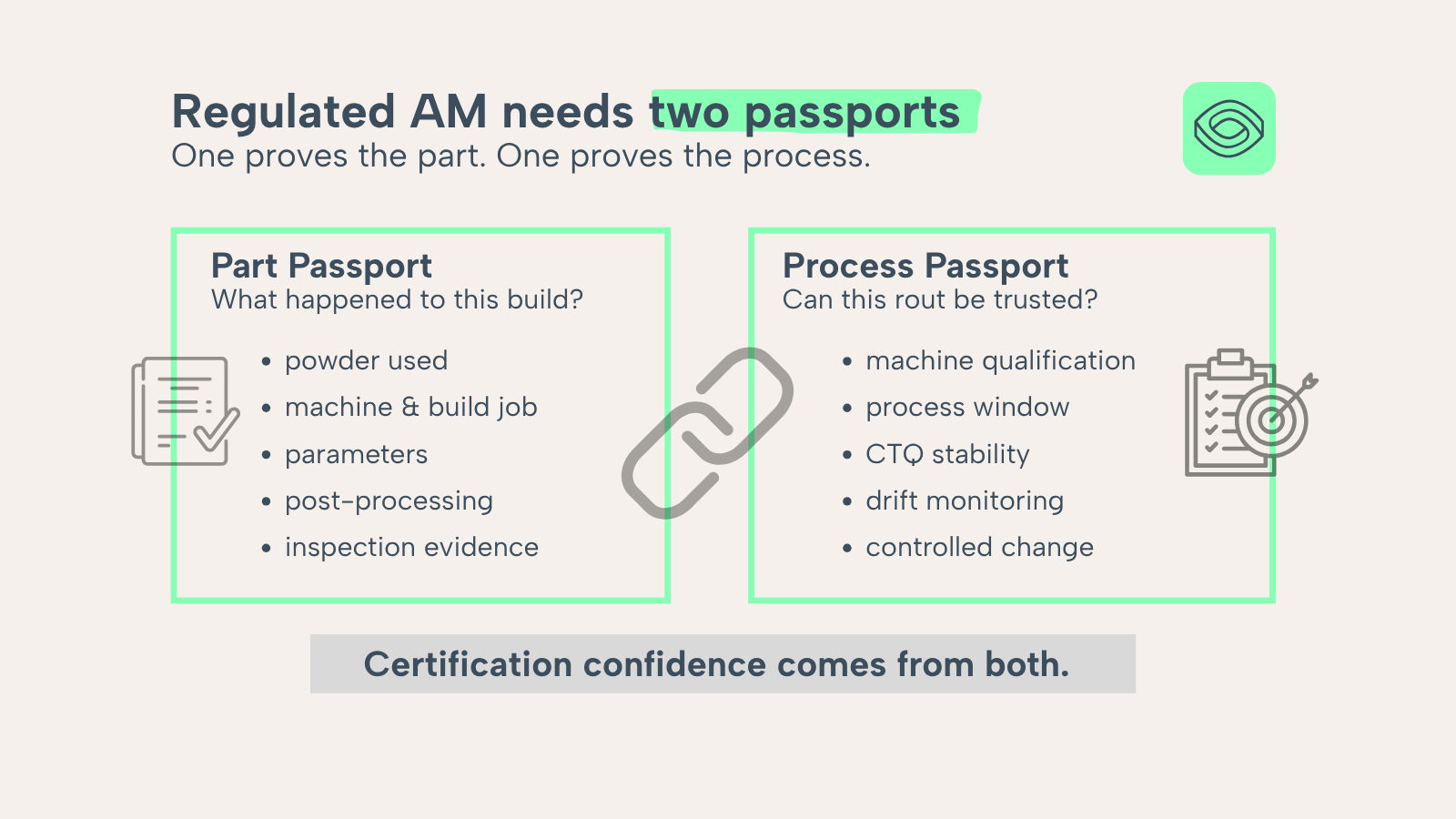
One useful way to explain this is to think in terms of two passports.
The first is the part passport. It answers the questions what happened to this specific component? Which powder was used? Which machine built it? Which parameters were active? What post-processing route followed? What inspection evidence proves conformity?
This is the logic behind Prove Part Conformity. It is delivery-level evidence. It tells the customer that the part in front of them has a complete, traceable quality story.
The second is the process passport. It answers bigger questions such as is the route itself trustworthy? Is the machine qualified? Is the process window understood? Are CTQs stable? Is drift monitored? Are changes controlled? Is documentation repeatable?
This is the logic behind Process & Machine Qualification. It is production-level evidence. It tells the customer that future parts can be manufactured with confidence, not recreated as new experiments.
Together, these two use cases provide a powerful framework, prove the part, then prove the process.
Why this matters commercially
For Heads of AM and QA leaders, process-centred quality is not only about compliance. It is a sales advantage. Customers in regulated sectors want suppliers who reduce uncertainty. A supplier that can generate part-level conformity evidence and process-level qualification evidence is easier to trust, easier to approve, and easier to scale with.
That does not mean eliminating audits. It means changing the tone of audits. Instead of scrambling to assemble proof, the supplier enters the conversation with connected evidence already available.
This is especially important as AM programmes move from prototype to production. Prototype quality can be managed with heroic effort. Production quality cannot. Production requires repeatable evidence, controlled variation, and structured quality data.
The shift AM needs
The next stage of AM maturity will not be defined only by better machines or more materials. It will be defined by better quality architecture.
Part-centred thinking will remain essential. Every component must conform, but regulated AM needs more than conformity at the point of delivery. It needs confidence in the route that created it.
That is why a digital quality backbone matters. It connects the evidence chain across powder, process, post-processing, and inspection, making quality something that is generated by production rather than reconstructed afterwards.
In certification-driven markets, the winning message is no longer simply “Here is the part, and it passed." It is: “Here is the part, here is the process, and here is the evidence that both can be trusted.”
Related articles
.png)
Blog Post
Architecting an Additive Manufacturing Software Stack
amsight doesn’t replace your MES or ERP - it fills the critical gap between them by owning the AM-specific quality evidence chain, so you stop assembling audit packs from spreadsheets and start proving part-level traceability, SPC, and process stability from powder to final inspection.
Aug 31, 2026
.png)
Let's Talk About Your AM Production
Book a call and we'll discuss your process, requirements as we share our findings and walk through why we built amsight.