.png)
There’s a moment every QA manager in additive manufacturing recognises. A customer emails, “We’ve seen a deviation. Please provide the full build history, powder details, post-processing route, inspection evidence, and any changes since the last accepted batch.”
The part is already printed. The physical work is done. Yet the real work is only just beginning.
You open a spreadsheet. Then another. You check the machine log. You hunt for a CT file in a shared drive. You ask production what powder blend they used. You cross-check a heat treatment certificate. You assemble a report that looks authoritative (but which feels fragile, because you know how much relied on “best effort”).
That is what “Excel hell” really is. Not the existence of spreadsheets. The existence of manual reconstruction as a normal operating mode.
A digital quality backbone is the antidote, but it isn’t “software you install”. It’s a design choice. Stop treating quality evidence as something you assemble after the fact. Treat it as something your process generates by default.
Build around part-level truth
Most spreadsheet workflows fail for one reason, and that is they don’t enforce relationships. In production AM, quality evidence is relational by nature. Powder history must connect to the build job; the build must connect to post-processing; post-processing must connect to inspection and tests. If those connections aren’t anchored to the part in a consistent way, traceability becomes interpretive. It works when the right person is available, and it falls apart when scrutiny increases.
The backbone principle is simple. The part becomes the primary object, and everything attaches to it through enforced links rather than naming conventions and memory.
Capture the chain, not just the printer
A second failure mode is “printer-only quality data”. Teams invest in build logs and monitoring, then discover that audits and customer questions rarely stop at the printer. They want to know powder genealogy, post-processing routes, inspection outcomes, and any deviations along the way. If your quality record doesn’t treat the AM process as one continuous chain, you’ll always be stitching evidence together under pressure.
A backbone captures end-to-end evidence because that is how your customers interrogate risk.
Standardise outputs, not just inputs
Most organisations assume the hard part is collecting data. In regulated production, the hard part is producing the same answer repeatedly.
Every shop can create an audit pack once. The operational question is whether you can generate it consistently, in the same structure, with the same logic, without rebuilding it manually each time. When reporting becomes a craft, you get “multiple truths”. Every engineer has their own spreadsheet, their own template, their own interpretation. That’s not audit readiness. That’s fragility.
A digital backbone is defined as much by repeatable evidence packs and report templates as it is by data ingestion. If you want a single source of truth, the output must be standard enough that people stop creating their own versions of the truth.
Make drift visible, not discoverable
The most expensive quality events in AM are rarely dramatic failures. More often, scrap creeps in through drift (slightly rising porosity rates, widening dimensional scatter, CT rejections clustering around one machine, or a subtle shift after a maintenance cycle).
Spreadsheet-based workflows tend to discover drift late because they are event-driven. You investigate after the failure. A backbone enables trend-driven thinking, so you see variation widening earlier, you quantify stability, and you intervene before the next batch becomes a write-off. This is the deeper reason QA leaders want centralised data, not simply to prove a part passed, but to prove the process is stable.
Keep the architecture sane
For CTOs and IT teams, “single source of truth” can sound like a warning sign, as if you’re proposing another monolithic platform. That’s not what a backbone needs to be.
In practice, the backbone is a specialised quality software that sits alongside ERP/MES and connects to machines and inspection systems. ERP remains the system of record for business truth. MES remains the system of record for execution truth. The backbone becomes the system of record for production-level AM quality truth, the granular evidence chain that other systems aren’t built to model natively.
This is why the backbone should simplify your landscape. It reduces spreadsheet glue, reduces bespoke one-off integrations, and reduces dependence on individuals.

First steps
A practical implementation doesn’t begin with “connect everything.” It begins with one narrow slice where the pain is obvious and the ROI is immediate.
Start by choosing a product family, customer programme, or machine cluster where documentation effort is high and inspection burden is costly. Define the minimum evidence chain for that slice (powder record, build job, post-processing route, inspection proof) and make it queryable at part level. Then standardise the evidence pack output so QA can generate it in minutes, not days. Once the chain is connected and reporting is repeatable, you can add trends and SPC views to make drift visible earlier and improvements measurable.
Where Traceable Production Data fits
This is exactly the rationale behind amsight’s “Traceable Production Data” use case, to link powder, process, post-processing and inspection evidence into a part-level record that can be queried, reported, and defended, without spreadsheet archaeology.
If your AM quality depends on people reconstructing reality from files, you don’t have a quality system, you have a coping mechanism. A digital quality backbone replaces coping with control. And that’s what production AM requires next.
Related articles
.png)
Blog Post
Architecting an Additive Manufacturing Software Stack
amsight doesn’t replace your MES or ERP - it fills the critical gap between them by owning the AM-specific quality evidence chain, so you stop assembling audit packs from spreadsheets and start proving part-level traceability, SPC, and process stability from powder to final inspection.
Aug 31, 2026
.png)
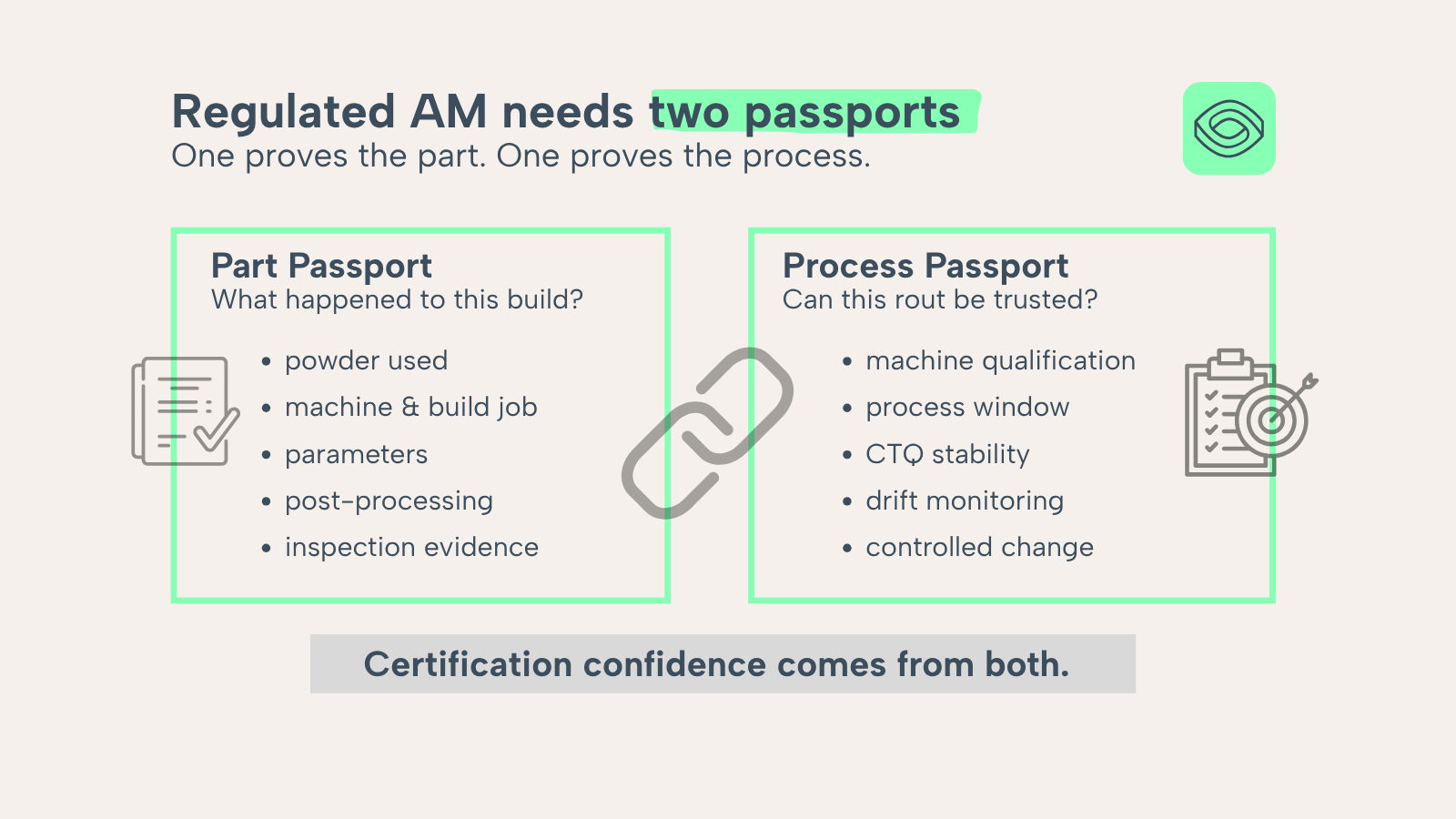
Blog Post
Process-Centred vs Part-Centred Thinking in Regulated Additive Manufacturing
Regulated AM customers are not only asking whether a part conforms. They want to know whether the process behind it is stable, repeatable and controlled. This article explains why mature AM suppliers need both a part passport and a process passport.
Jul 28, 2026
Let's Talk About Your AM Production
Book a call and we'll discuss your process, requirements as we share our findings and walk through why we built amsight.