.png)
A prototype can be celebrated with a photo. A certified series process has to survive cross-examination. That’s the difference between “we printed a part” and “we can supply a programme.”
In regulated industries such as aerospace, defence, or semiconductor, additive manufacturing is no longer judged only on technical capability. It’s judged on repeatability, control, and evidence. Customers and auditors don’t just ask whether a part met spec, they ask whether you can prove how it was made, whether the process is stable over time, and whether changes are controlled in a way that aligns with the logic of ISO/ASTM qualification thinking.
This is where many AM initiatives stall. Not because the process can’t produce good parts, but because the quality record is assembled from fragments.
Why audits fail
Most AM teams do have the raw materials of audit evidence such as powder certificates and batch numbers, build logs and parameter sets, post-processing records, and inspection results. The problem is the shape of that evidence. It’s often scattered across PDFs, spreadsheets, screenshots and shared drives, held together by tribal knowledge.
Auditors don’t reward storage. They reward coherence. They want a story that is part-level, complete across the process chain, and repeatable to generate again next week without manual heroics. If your audit response depends on someone hunting through folders, your audit readiness depends on time, luck, and individuals. That’s not scalable.
The three questions your data trail must answer
A robust audit trail is designed to answer three questions quickly and consistently.
First: What exactly happened to this part? Can you link powder state (including reuse/mix history), build job, parameter set, machine context, post-processing route, and inspection evidence into one chain? “We have the files” is not enough, Auditors want the relationships.
Second: How do you know the process is stable? A single conformance report proves an outcome. Regulated customers increasingly want evidence of capability over time — trend views, drift detection, CTQs and the rationale for control limits. They want to see that your process doesn’t merely produce good parts occasionally, it produces them reliably.
Third: What changed — and how did you assess risk? Additive manufacturing evolves. Parameters get refined, machines are maintained, powder strategies adjust, inspection plans change. Audit-ready operations don’t hide change; they document it. They can show what changed, when, why, and how impact was evaluated against CTQs.
If those three answers are slow, inconsistent, or dependent on bespoke manual report building, you’re not “unready”, you’re just missing infrastructure.
Designing the data trail
The mistake many organisations make is treating audit readiness as a documentation project. In production AM it’s better seen as a data architecture project. The goal is to turn scattered information into a structured, quarriable record that can withstand scrutiny.
A practical blueprint looks like this:
- Anchor everything to the part through consistent IDs and genealogy, so the evidence chain cannot drift.
- Capture the chain end-to-end (powder, build, post-processing and inspection) because audits rarely stop at the printer.
- Standardise reporting so evidence packs are generated from templates, not rebuilt from scratch under pressure.
- Build stability evidence into everyday operations, so SPC and drift detection are not “special projects” but normal production practice.
Notice what’s missing here, “more paperwork.” The objective is fewer heroics, fewer one-off reports, and far less spreadsheet archaeology.
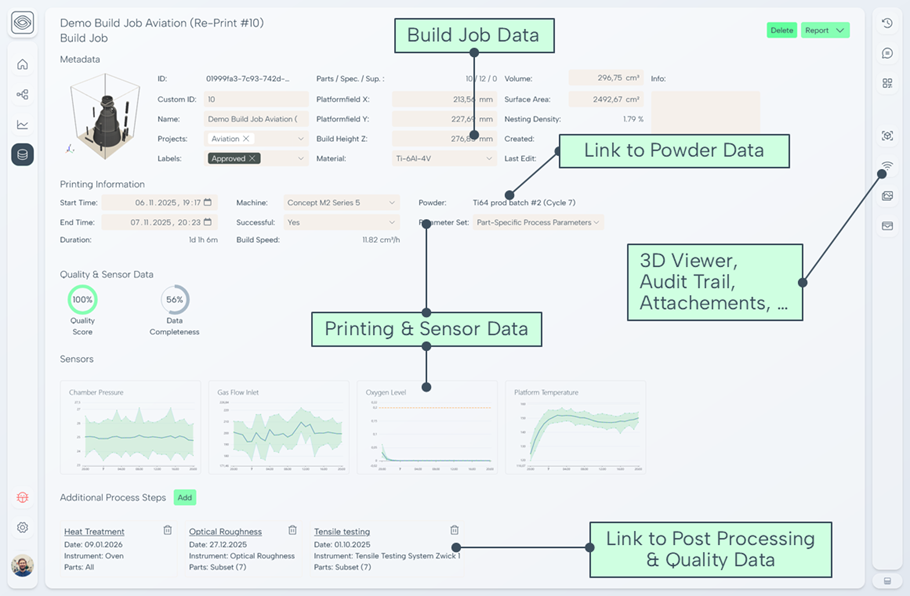
Where amsight fits
Here are two complementary use cases.
Prove Part Conformity is about generating consistent, audit-ready evidence packs at part level, fast, repeatable, and defensible.
Process & Machine Qualification is about demonstrating and maintaining stability over time, the capability story that sits behind certification and supports controlled reductions in inspection burden.
Together, these use cases support the shift from “documenting after the fact” to designing the data trail up front.
Certification is a data problem
Many organisations assume certification is mostly about documents. Documents matter, but they’re the surface. What auditors are really testing is whether you have a controlled process, and whether your evidence can be interrogated without collapsing into manual reconstruction.
If you want certified series production, you have to design the data trail as carefully as you design the part. Because in aerospace and defence, success isn’t printing one perfect build.
It’s printing the next hundred, and proving every one.
Related articles
.png)
Blog Post
Architecting an Additive Manufacturing Software Stack
amsight doesn’t replace your MES or ERP - it fills the critical gap between them by owning the AM-specific quality evidence chain, so you stop assembling audit packs from spreadsheets and start proving part-level traceability, SPC, and process stability from powder to final inspection.
Aug 31, 2026
.png)
Blog Post
Process-Centred vs Part-Centred Thinking in Regulated Additive Manufacturing
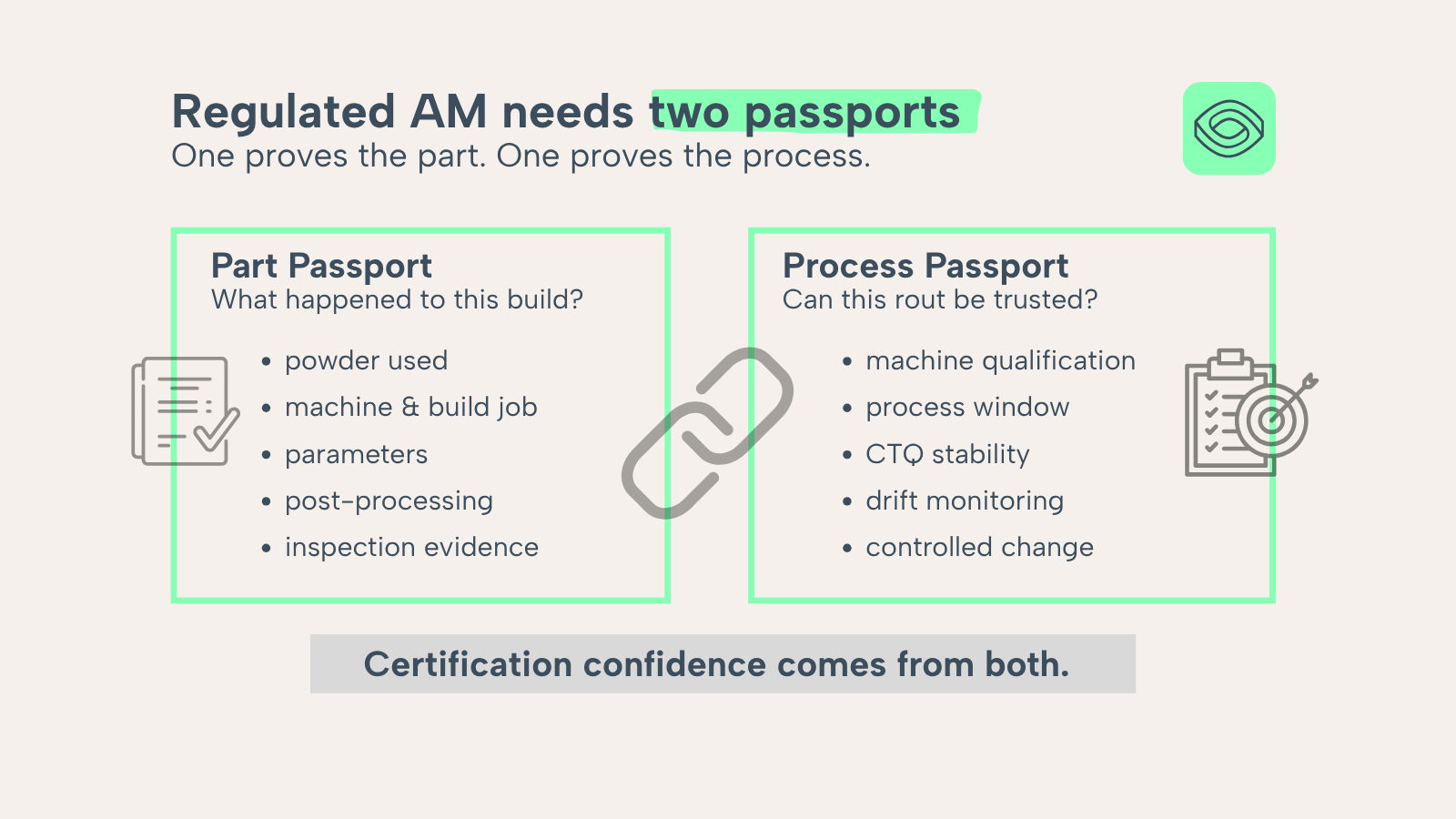
Regulated AM customers are not only asking whether a part conforms. They want to know whether the process behind it is stable, repeatable and controlled. This article explains why mature AM suppliers need both a part passport and a process passport.
Jul 28, 2026
Let's Talk About Your AM Production
Book a call and we'll discuss your process, requirements as we share our findings and walk through why we built amsight.