.png)
Spreadsheet-based AM quality management rarely fails with a bang, it fails in a series of ten-minute losses. Ten minutes to find the powder record. Twenty minutes to check which spreadsheet is current. Half an hour to rebuild the build history. Another hour to pull inspection evidence into the report.
Then someone checks the file names, confirms the template, fixes the formatting, tracks down a missing CT result, and makes sure the evidence tells the same story as last time.
None of this looks catastrophic, that is why it has survived for so long. But add these tasks across a week, across machines, materials, builds, audits, customer requests, and qualification work, and Excel starts to look less like a useful tool and more like a hidden labour system.
For many AM teams, the cost of spreadsheets is not the licence fee. It is the skilled QA time spent holding the evidence chain together by hand.
The “extra day” question
A useful way to expose the problem is to ask one simple question, “What would your QA team do with an extra day a week?” Not an extra day for more administration. An extra day for work that actually improves the factory.
That time could go into analysing process drift, reducing scrap, improving inspection strategy, tightening powder controls, preparing stronger customer evidence, shortening non-conformance investigations, or supporting process qualification more proactively.
Instead, many AM operations and quality teams spend that time reconstructing what already happened. They are not short of judgement, they are short of usable, connected evidence.
Where the time goes
The time loss usually sits in a few familiar places.
- Evidence collection is the first. Powder information, machine data, build files, post-processing records, and inspection results often live in different systems, folders, or spreadsheets. QA has to retrieve and reconcile them manually.
- Version checking is the second. Spreadsheet-based quality management depends on discipline, the right file, the right template, the right revision, the right customer requirement, the right report copied from the right previous job.
- Then comes report building. For regulated or quality-critical work, evidence packs can become manual publishing projects. The part may be complete, but the proof still has to be assembled.
- Investigations create another cost. When something goes wrong, root-cause analysis should begin with “what changed?” Too often, it begins with “where is the data?”
- Qualification adds still more pressure. Repeatability evidence, SPC views, capability trends and machine/process comparisons are difficult to maintain when the data backbone is missing.
Individually, each task feels manageable. Together, they create a parallel production process whose output is proof.
Why this matters to Heads of AM
For Heads of AM, this is not only a QA efficiency issue, it’s a production maturity issue. As AM scales, manual evidence assembly becomes harder to sustain. More machines create more data sources. More materials create more traceability requirements. More regulated customers create more reporting pressure. More qualification work creates more need for repeatable evidence.
At some point, the ability to document production becomes a constraint on production itself.
That is why “beyond Excel” is not a software preference. It is an operating decision. A digital quality backbone changes the work. Instead of asking people to rebuild the quality story after the fact, the system connects powder, process, machine, post-processing, and inspection data at part level as production happens. Reporting becomes an output of the process, not a project after the process.
When time saving becomes process control
The Process & Machine Qualification use case is a good place to see why this matters.
Qualification is not only technically demanding, it’s administratively heavy. Teams have to compare builds, document machine behaviour, analyse test data, assess repeatability, create charts, and prove that the process is stable enough to trust. If that evidence is assembled manually every time, qualification becomes slower than it needs to be.
When SPC, drift monitoring, capability trends, and repeatability evidence are built into the quality system, qualification becomes more maintainable. Teams spend less time recreating proof and more time understanding whether the process is actually under control.
That is the real shift, from evidence assembly to process learning. Stable processes also reduce the need for defensive inspection. They shorten investigations. They make it easier to answer customer questions. They help quality teams move from explaining failures to improving the process that produced them.
A simple internal calculation
Ask your QA team how much time is spent each week on finding, checking, copying, formatting, reconciling, and reporting AM quality data. Then multiply that by 48 working weeks. Now ask what that time could have achieved if it had been spent on scrap reduction, root-cause learning, qualification readiness, or process stability.
That number is the real cost of spreadsheet-based AM quality management, and it is usually higher than expected.
The better use of QA time
QA people should not be used as human data connectors. Their value is judgement, risk reduction, improvement, and production confidence. When they are trapped in spreadsheets, the organisation loses access to that value.
Replacing spreadsheets is not about making reports prettier. It is about giving time back to the people who can make AM more reliable. That is the case for a demo. Not “show us another software tool,” but show us how much manual reporting effort can be reduced, how much faster quality evidence can be accessed, and how quickly we can move from evidence assembly to process control.
Because in production AM, an extra day a week of QA time is not an administrative saving, it is undeniably a competitive advantage.
Related articles
.png)
Blog Post
Architecting an Additive Manufacturing Software Stack
amsight doesn’t replace your MES or ERP - it fills the critical gap between them by owning the AM-specific quality evidence chain, so you stop assembling audit packs from spreadsheets and start proving part-level traceability, SPC, and process stability from powder to final inspection.
Aug 31, 2026
Blog Post
Process-Centred vs Part-Centred Thinking in Regulated Additive Manufacturing
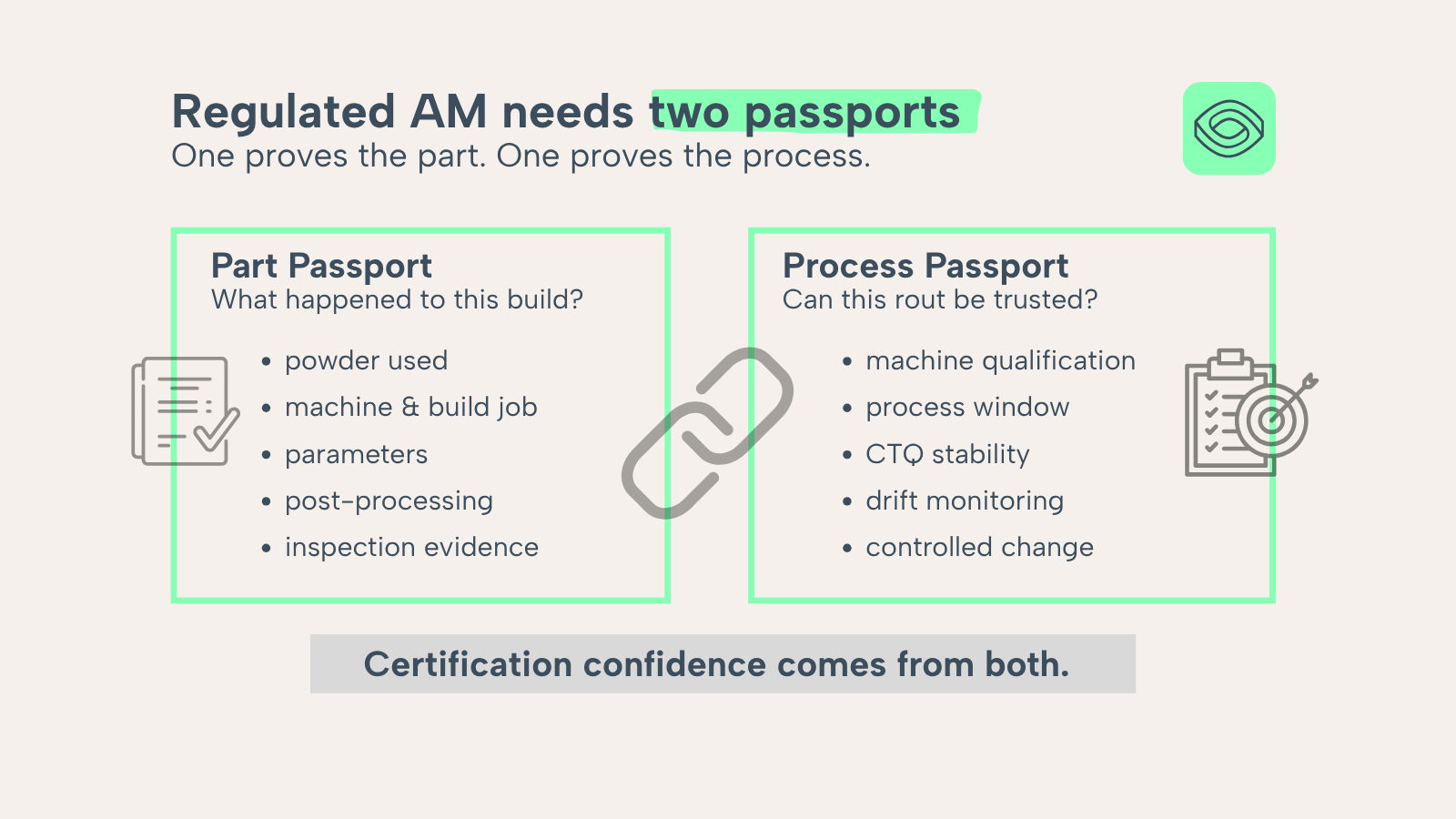
Regulated AM customers are not only asking whether a part conforms. They want to know whether the process behind it is stable, repeatable and controlled. This article explains why mature AM suppliers need both a part passport and a process passport.
Jul 28, 2026
.png)
Let's Talk About Your AM Production
Book a call and we'll discuss your process, requirements as we share our findings and walk through why we built amsight.