Additive manufacturing is forcing a quiet reinvention of quality management. Not because quality suddenly matters more than it did in aerospace, defence or medical manufacturing, it always mattered. But because AM changes what “quality evidence” looks like. In traditional manufacturing, evidence often concentrates around approved procedures, controlled drawings, calibrated equipment, and inspection results. In powder-bed AM, the evidence is more granular, more interconnected, and more sensitive to drift over time.
That’s why many organisations feel an uncomfortable gap. They have a QMS, they have ERP, they may even have MES, and yet (when an auditor or customer asks a pointed question about a specific part) the answer still lives in spreadsheets and shared folders.
The issue isn’t discipline. It’s that AM has outgrown a purely document-centric view of quality.
What document control can’t do (at production speed)
A conventional QMS excels at governing processes:procedures, approvals, training records, non-conformance workflows, CAPA, and audit trails around documentation. It’s designed to ensure the organisation behaves consistently. But ask it to produce a coherent, part-level story of AM production and it struggles, not because it’s “bad software”, but because that’s not what it was built for.
In production AM, the questions that matter often sound like this:
- Which powder batch and reuse state was used for this build, and where is that recorded?
- Which parameter set and machine condition applied, and did anything drift?
- What post-processing route was followed, and can we prove it?
- Which inspection results apply to this exact serialised part, and what changed since the last accepted run?
These questions cross the entire chain. They require linked evidence, not a collection of files. When teams respond by manually assembling evidence packs — copying from logs, pulling PDFs, rebuilding reports in Excel — they can “pass” the audit. But they do it by effort, not by system. In regulated production, that difference becomes a strategic risk.

The key shift
AM pushes quality management toward a new centre of gravity, namely process evidence. Process evidence is structured, queryable, and connected at part level. It makes it possible to answer questions quickly and consistently, because the relationships between powder, build, post-processing, and inspection are enforced, not implied.

This doesn’t replace document control. It complements it. In other words, we’re not saying, “throw out your QMS.” We’re saying, “recognise what it isn’t designed to do, and stop forcing it to become something else.”
Where production-level quality software fits
This is where the idea of a “production-level QMS for AM” becomes practical. It’s not a rebranded document system. It’s a specialised quality management software in the production stack that focuses narrowly on AM evidence chains. For CTOs and integration partners, it’s helpful to think in terms of different kinds of truth:
- ERP holds commercial truth (orders, finance, inventory).
- MES holds execution truth (workflow, routing, status).
- A document-centric QMS holds governance truth (procedures, approvals, compliance framework).
- A production-level quality management software (P-QMS) holds process evidence truth (powder → build → post-processing → inspection, linked at part level).
That P-QMS sits alongside MES/ERP in the production environment, integrating with machines and inspection systems, but it isn’t trying to schedule work or run finance. It exists to make quality evidence usable at scale. This is the gap amsight is built to fill.
Why AM-specific modelling matters
AM fleets are heterogeneous including different OEMs, different generations, different log formats, different inspection flows. Traditional systems can store attachments and notes, but they rarely normalise AM data into a consistent model that supports cross-machine comparison, drift detection, or repeatable reporting. That modelling matters because it changes what you can do operationally:
- You can move beyond “prove it passed” to “prove it’s stable.”
- You can build repeatable reporting templates instead of rebuilding evidence packs per customer.
- You can run SPC and trend analysis without starting every month by cleaning spreadsheets.
In production terms, that’s how you reduce scrap and inspection burden over time, not by adding more paperwork, but by turning data into control.
Qualification
The moment AM enters regulated production, qualification becomes the proving ground. IQ/OQ/PQ style thinking forces a process-level view. You’re not only proving the part, you’re proving the process can produce the part repeatedly.
That’s why “Process & Machine Qualification” naturally sits next to “Prove Part Conformity” in production AM. One is about evidence for this part, the other is about evidence that the process is stable enough to trust the next hundred parts.
If your qualification evidence lives in spreadsheets and PowerPoints, you can still qualify, but sustaining and scaling that qualification becomes painful. A production-level QM software makes qualification evidence maintainable over time, which is ultimately what regulated customers demand.
A practical starting point
If you want to test whether your current quality architecture is document-heavy but evidence-light, try this. Pick one shipped part and ask whether you can retrieve, in minutes, a coherent chain of evidence (powder history, build job, post-processing route, inspection results) and a clear record of what changed since the last accepted run. If the answer involves multiple files, multiple people, and manual collation, you’ve found the gap.
The takeaway
AM isn’t killing the QMS. It’s evolving it. In a world where production is data-rich and regulated customers demand speed, consistency and proof, quality management can’t stop at documents. It has to include process evidence that behaves like a system.
That’s what “production-level QMS for AM” really means, and why a dedicated AM quality management software is quickly becoming part of the modern production stack.
Related articles
.png)
Blog Post
Architecting an Additive Manufacturing Software Stack
amsight doesn’t replace your MES or ERP - it fills the critical gap between them by owning the AM-specific quality evidence chain, so you stop assembling audit packs from spreadsheets and start proving part-level traceability, SPC, and process stability from powder to final inspection.
Aug 31, 2026
.png)
Blog Post
Process-Centred vs Part-Centred Thinking in Regulated Additive Manufacturing
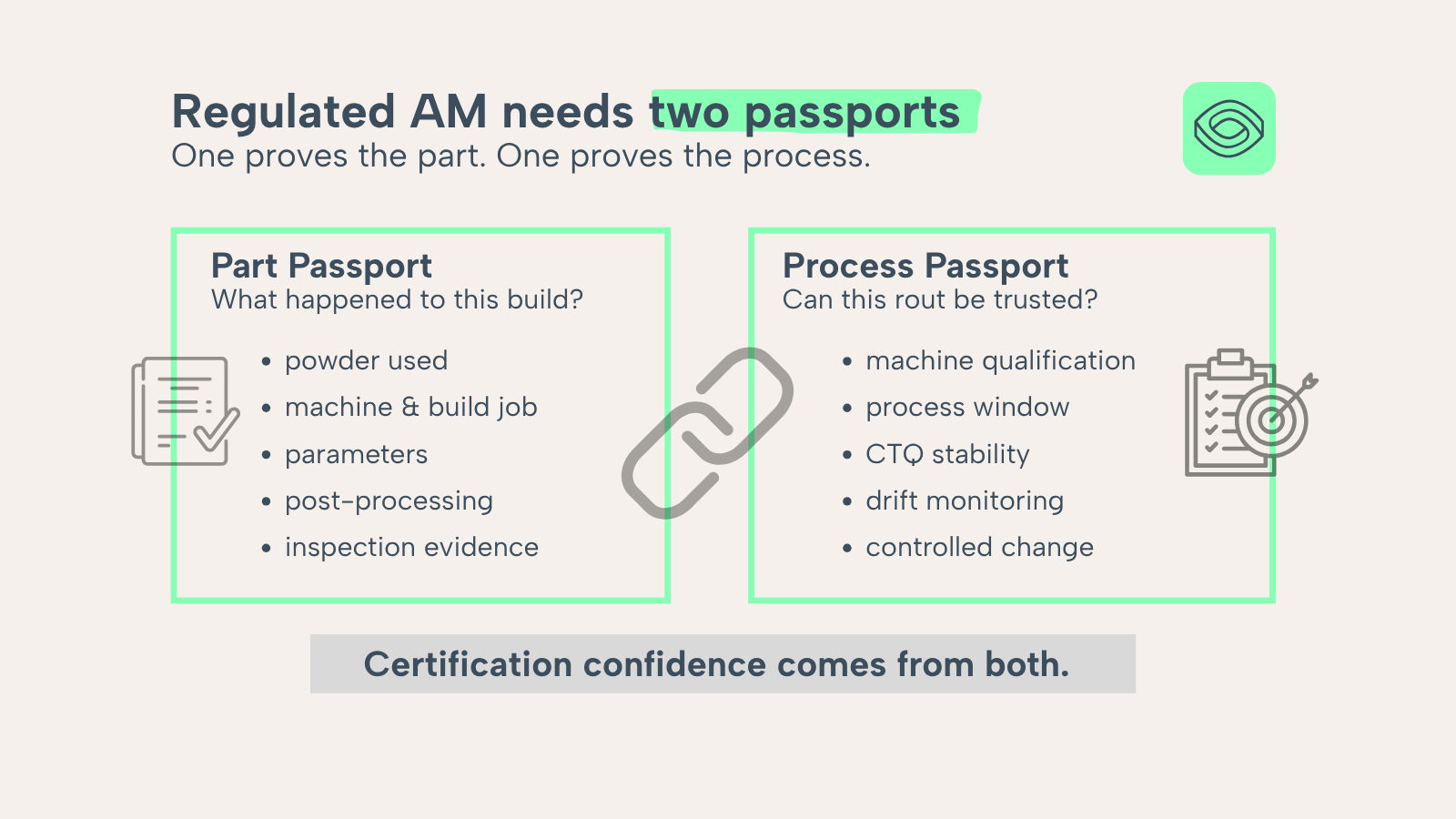
Regulated AM customers are not only asking whether a part conforms. They want to know whether the process behind it is stable, repeatable and controlled. This article explains why mature AM suppliers need both a part passport and a process passport.
Jul 28, 2026
Let's Talk About Your AM Production
Book a call and we'll discuss your process, requirements as we share our findings and walk through why we built amsight.