Quality evidence is often treated as something prepared for auditors. That view is too narrow.
Especially in regulated additive manufacturing, quality evidence is also a commercial asset. It shows customers that a supplier is not only technically capable, but ready for repeatable production. It proves that the organisation understands customer risk, can support qualification work, and can explain how a part was produced beyond a successful one-off build.
This matters because in highly regulated sectors such as aerospace, defence, medtech, semiconductor and oil and gas customers are not buying AM parts in isolation. They are buying confidence. They are buying the assurance that, once the design freezes, the production process will not become a mystery with every new batch.
That is where digital quality management changes the conversation.
Stop leading with compliance language
Most AM suppliers instinctively talk about quality in the language of internal systems such as ISO/ASTM, traceability, process qualification, inspection reports, audit readiness, nonconformance, CAPA.
There is nothing wrong with that language. It is necessary. But it is not always the language that wins customer confidence. A customer hears those words through a different filter. They are asking, “Will this supplier make my approval process harder or easier? Will they be able to answer technical questions quickly? Will they spot drift before it affects my programme? Will I get consistent documentation, or will every delivery trigger another round of emails?”
In other words, the commercial value of digital quality is not “we can find the documentation if you need it.” It is “we can reduce your risk by proving control, consistency and traceability.” That is a much stronger conversation.
Quality evidence as a sales argument
In traditional sales conversations, AM suppliers often lead with capability such as machine fleet, materials, tolerances, build volume, lead time, design freedom.
Those are important. But in regulated sectors, they are not enough. Many suppliers can produce a good sample. Far fewer can prove, repeatedly, that the process behind that sample is stable, documented, and scalable.
That distinction is where quality evidence becomes a differentiator. A supplier with a robust digital quality backbone can make a different kind of promise:
We can show the powder history behind this part. We can show the build context, the post-processing route, the inspection evidence, and what changed compared with previous accepted builds. We can show stability over time, not only conformity today. We can support your qualification logic with structured data rather than manual report assembly.
That is not just a QA claim. It is a commercial claim. It says that working with us will make your approval pathway cleaner.
From audit pack to customer confidence pack
The term “audit pack” is useful, but limiting. It implies the evidence exists for a formal review at a specific point in time. For customers, the more powerful concept is a confidence pack.
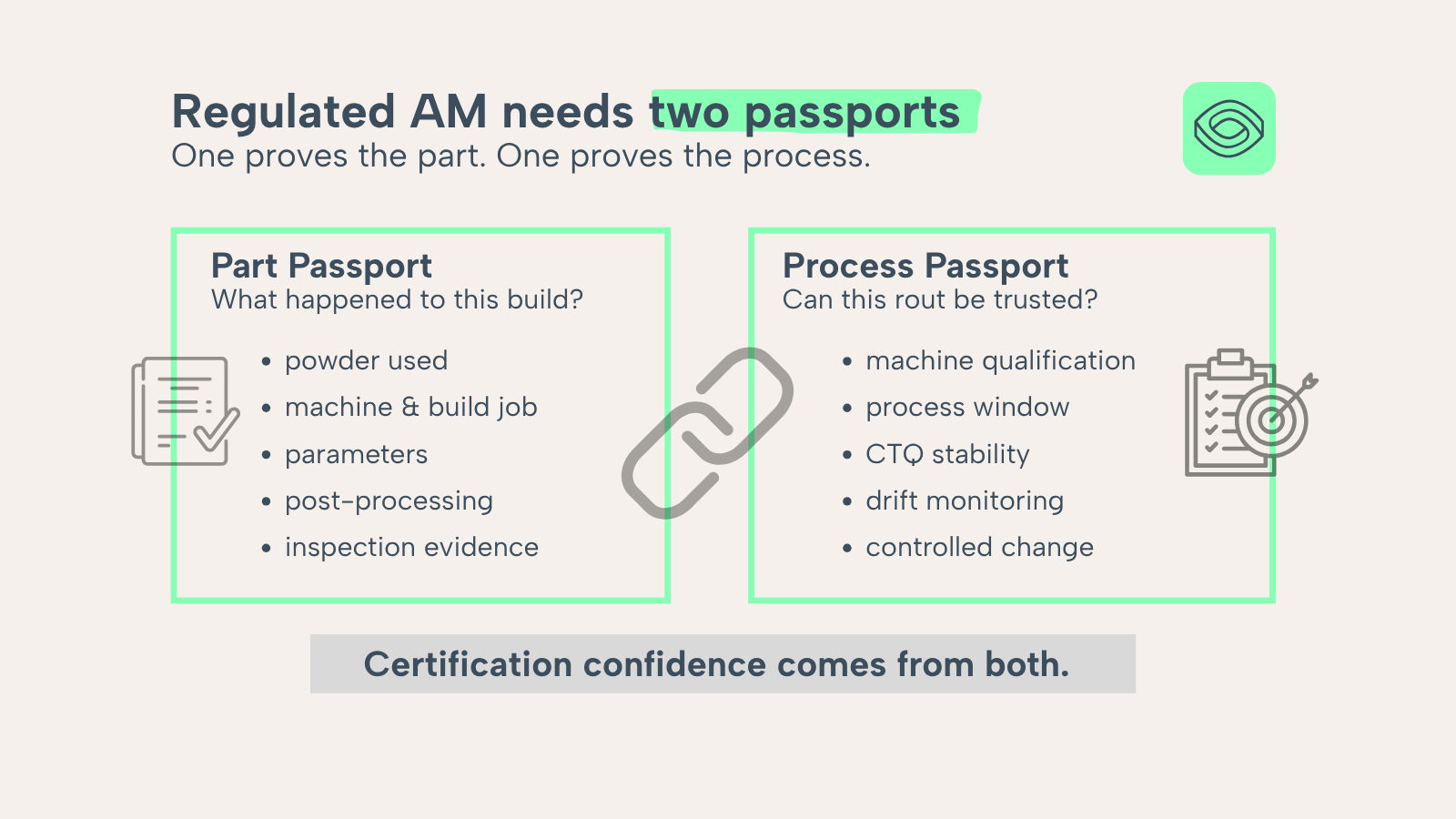
That confidence pack answers two different questions. First, did this part conform? That is the immediate, delivery-level question. It requires part-level evidence (material state, build information, process route, inspection results and any deviation history). Second, is this process dependable? That is the programme-level question. It requires stability evidence (qualification data, CTQs, repeatability, process windows, controlled change, and trend behaviour over time).
These two questions map directly to the way sophisticated AM customers make decisions. A single part may pass inspection, but a programme only moves forward when the customer believes the process can keep passing. That is why the amsight use cases Prove Part Conformity and Process & Machine Qualification should not be positioned only as technical functions. They are customer communication tools. Prove Part Conformity supports the part-level promise, here is the evidence for what was delivered. Process & Machine Qualification supports the production-level promise, here is the evidence that the process is controlled enough to keep delivering.
Together, they turn quality from a defensive function into a commercial language.
ISO/ASTM as shared vocabulary
Standards are often presented as a burden, something suppliers must satisfy to be allowed into regulated markets. That is true, but incomplete.
ISO/ASTM frameworks also create a shared vocabulary between supplier and customer. They help both parties talk about qualification, traceability, repeatability, risk, and process control in a structured way.
The commercial opportunity is to use that vocabulary proactively. Instead of waiting for the customer to ask, “How do you manage traceability?” the supplier can show how traceability is built into the production data model. Instead of waiting for an auditor to ask, “How do you know the process is stable?” the supplier can demonstrate how qualification evidence is maintained over time.
This changes the tone of the conversation. The supplier is no longer reacting to quality demands. The supplier is leading the maturity discussion. That leadership matters in sectors where customers are still deciding which AM partners are ready for serious production.
The hidden commercial cost of weak evidence
Poor quality evidence does not only createaudit pain. It creates sales friction. When documentation is slow, customerswait. When evidence is inconsistent, customers hesitate. When root-causeanalysis takes days because data is scattered across spreadsheets, confidencefalls. When every deviation becomes a bespoke investigation, the supplier looksless scalable than its machine list suggests.
This is why manual reporting is not aback-office inconvenience. It is a commercial drag. A supplier may betechnically excellent, but if its evidence chain is fragile, customers willfeel that fragility. They may not say, “Your data architecture concerns us.”They will say, “We need more assurance,” “We need additional inspection,” “Weneed another review,” or “We are not ready to move this into series.”
Those phrases all cost time.
How to talk about digital quality with customers
The best customer conversations avoid software jargon. They focus on outcomes. Do not start with dashboards. Start with confidence. Say, we can give you a structured part history, not a folder of documents. We can show process stability, not just final inspection. We can reduce investigation time because powder, process, and inspection data are connected. We can support qualification discussions with evidence that is repeatable, not manually rebuilt. That is the message customers understand.
For QA teams, digital quality means less manual documentation. For operations, it means earlier drift detection and fewer surprises. For customers, it means lower programme risk. The same system creates value for all three groups, but the language must change depending on who is listening.
The Strongest Argument Is Proof
The next competitive edge in regulated AM will not only be: who can print the most complex part. It will be: who can make AM feel safe, repeatable, and explainable to customers who cannot afford uncertainty. That requires more than good intentions and organised folders. It requires a digital quality backbone that turns quality evidence into a living asset.
For AM suppliers, the opportunity is clear. Stop treating quality documentation as an obligation at the end of the process. Start using it as proof of maturity at the beginning of the customer conversation.
Because in regulated AM, the best commercial argument may not be “look what we can make.” It may be "look how confidently we can prove it".
Related articles
.png)
Blog Post
Architecting an Additive Manufacturing Software Stack
amsight doesn’t replace your MES or ERP - it fills the critical gap between them by owning the AM-specific quality evidence chain, so you stop assembling audit packs from spreadsheets and start proving part-level traceability, SPC, and process stability from powder to final inspection.
Aug 31, 2026
.png)
Blog Post
Process-Centred vs Part-Centred Thinking in Regulated Additive Manufacturing
Regulated AM customers are not only asking whether a part conforms. They want to know whether the process behind it is stable, repeatable and controlled. This article explains why mature AM suppliers need both a part passport and a process passport.
Jul 28, 2026
Let's Talk About Your AM Production
Book a call and we'll discuss your process, requirements as we share our findings and walk through why we built amsight.